CubeAway - 3DPuzzle
- 4.5
- Rating
- 5.00M
- Installs
- Free
- Price

 Analysis by App-foxy
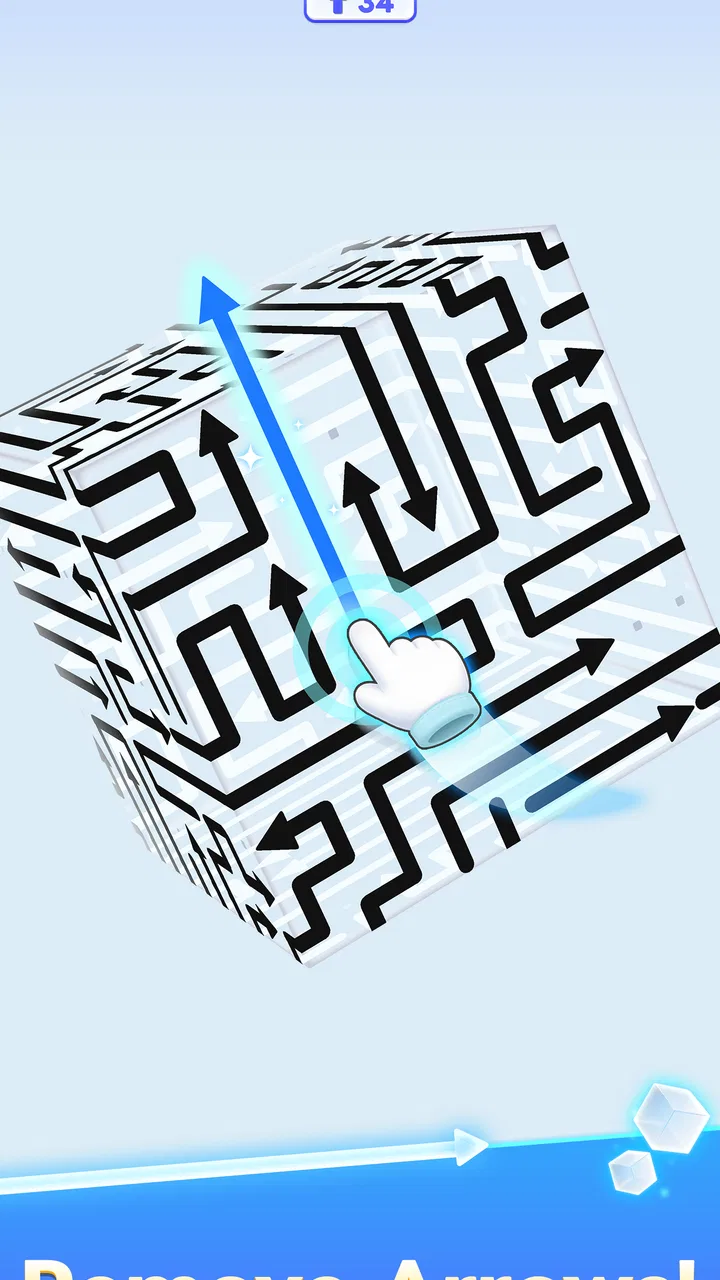
I picked up ArrowCube - 3DPuzzle expecting a small time-killer, and that is exactly where it makes the best first impression. The whole idea is easy to understand at a glance: you look at a six-sided cube covered with arrows and remove them in a workable order until the shape is clear. There is no long tutorial to decode and no story to follow before the puzzle begins. I can open it, understand the objective almost immediately, and start making decisions within seconds.
That directness matters more than it may sound. Many puzzle games spend their opening minutes teaching systems, presenting menus, or pushing several modes at once. This one puts its central visual problem first. As a free puzzle game from GOODROID,Inc., it feels designed for the moment when I have a little attention available but not enough patience for a large commitment. The result is a compact experience that works particularly well in short bursts, provided I am in the mood to examine space rather than simply tap through obvious matches.
Why the cube is satisfying to read
The appeal comes from turning a familiar object into a small spatial argument. An arrow is not just a symbol to remove; its direction affects whether the move makes sense. I have to look at the visible faces, notice which pieces are exposed, and avoid treating the cube like a flat board. That gives each move a modest sense of consequence. The pleasure is not in fast reactions but in seeing a blocked arrangement become readable.
You May Also Like

 Blood Strike: 2.5 Anniversary
Blood Strike’s Loadouts Turn Every Drop Into a Tactical Gamble
A close look at Blood Strike’s custom loadouts: how fast access to signature weapons reshapes its battle royale rhythm, rewards preparation, and narrows the gap between fights.

 Pandora - Music & Podcasts
Pandora’s Music Is Easy to Start, but Harder to Recover
Pandora’s strength is its low-effort path from a seed to a station. Its weak spot is how much confidence it asks you to place in connection, setup, and quiet recovery.

 8 Ball Pool
 Is Built on Rivalries, Rematches, and Routine
A close look at the rivalries, rematches, shared routines, and unanswered safety questions that turn a quick pool match into a persistent mobile community.

 Samsung Music
’s Quiet Strength Is Playing What You Already Own
Its reach comes less from spectacle than from dependable access to a personal library. That simplicity is both the app’s strongest retention engine and its ceiling.

 AccuWeather: Weather Radar
AccuWeather Review: A Quick, Clear Forecast for Everyday Decisions
For everyday plans, the best forecast is the one you can understand quickly. AccuWeather makes rain timing, radar, and local conditions easy to act on, with a few trade-offs.

 Hill Climb Racing
Why Hill Climb Racing Still Turns Crashes Into One More Run
A tiny car, a bumpy hill and one more upgrade: Hill Climb Racing keeps resurfacing because its simple chaos makes every near-miss feel personal.
More From Our News Desk
View All News


The six-sided structure also gives the game a useful middle ground. It is more interesting than a simple row-clearing puzzle, but it is not so complicated that I need to draw diagrams or memorize a large rule set. When I make progress, the cube gradually loses visual noise, which makes the payoff immediate. I can see why the game has attracted a 4.5 average from around 70K ratings and passed 1M+ installs: the basic interaction is approachable, and the visual goal is clear without being completely mindless.
My best results came when I stopped looking for the first arrow that seemed removable and instead scanned the cube as a whole. I check the outer edges, compare the directions on neighboring faces, and ask which move will reveal the most useful space. That habit is more valuable than speed. A player who taps impulsively can create a frustrating sequence of apparently bad choices, while a player who spends a few seconds surveying the object often finds a cleaner route.
This is also where the game separates itself from familiar match-three puzzles. Match-three games usually reward pattern recognition across a grid, often with cascading effects and colorful chain reactions. ArrowCube is quieter and more deliberate. It asks me to understand orientation and access rather than hunt for identical pieces. On the other hand, it does not provide the same explosive feedback or constant stream of surprises, so anyone seeking a highly animated arcade puzzle may find it restrained.
A rhythm that fits spare minutes
The strongest part of my experience was the session rhythm. A round can begin with a simple-looking arrangement, then slow me down once several arrows compete for attention. That change happens naturally: I start with quick observations, make a few confident removals, and then reach the point where I need to rotate my attention around the cube. The game therefore creates a small arc without demanding a long sitting.
I can imagine using it while waiting for a coffee, between appointments, or during a short break when I want something more engaging than scrolling. It suits those moments because the objective stays in my head. I do not need to remember a plot, rebuild a team, or restore a complicated setup. I simply return to the cube and ask what can safely move next.
That short-session strength has a trade-off. The game is not the kind of puzzle I would choose when I want a deep evening challenge with a large collection of distinct mechanics. Its core question remains consistent, and the enjoyment depends on how much variety the individual arrangements provide. If I play for too long in one sitting, the act of inspecting arrows can begin to feel like work rather than a refreshing break.
For me, the right approach is to stop after a satisfying handful of puzzles instead of forcing a marathon. The game rewards attention, but attention has a limit. Treating it as a pocket-sized mental reset preserves the sense of discovery. Trying to extract hours from the same basic interaction makes its narrow focus more obvious.
What happens when I am interrupted
ArrowCube is especially comfortable for irregular play. If a notification, conversation, or real-world task pulls me away, the puzzle does not require me to keep a rhythm or react within a strict window. That makes it more interruption-friendly than timing-based puzzle games, where returning after a pause can mean losing a run or missing a critical moment.
When I come back, the visual state itself helps me recover. Removed arrows change the shape of the problem, so I can inspect the remaining pieces and rebuild my plan from the current position. I do not need a detailed memory of every earlier tap. This is an understated strength: the game’s progress is visible rather than hidden in a complicated chain of events.
There is still a small mental cost after a long interruption. If I had been comparing several faces before putting the phone down, I may need to repeat that scan. That is not a serious flaw, but it means the game is interruption-tolerant rather than interruption-proof. The best way to return is to pause before tapping and look again at the entire cube, especially the edges where access can change quickly.
This makes it a good fit for people who play in fragments. A parent waiting outside an activity, a commuter with an unpredictable journey, or someone taking brief screen breaks can get value from it without committing to a fixed session. Players who prefer uninterrupted concentration may enjoy the same quality for a different reason: the game lets them think without adding pressure from a clock.
Small decisions instead of frantic tapping
The most useful technique I found is to treat every removal as information. I do not only ask whether an arrow can be removed; I ask what the move will expose and whether it will make the next decision easier. A move that clears a central obstruction may be better than one that is immediately available but leaves the surrounding faces just as crowded.
Another practical habit is to inspect the cube from several visual angles before committing to a sequence. The front face can make an arrow look like the obvious choice, while a neighboring face reveals that another piece is controlling access. I found that a brief full-cube scan prevents many unnecessary mistakes. It also makes the game feel more like a spatial puzzle than a tapping exercise.
I would not recommend rushing simply because the early moves look easy. Early certainty can be misleading. The more open the cube becomes, the more tempting it is to remove anything that appears free. Sometimes preserving a useful arrangement for one more move gives a clearer path. This is the kind of small trade-off that gives the game its mental texture without making it inaccessible.
That texture is also why the game may appeal to players who find traditional logic puzzles too abstract. The object is concrete, the arrows are visible, and progress has a physical-looking shape. At the same time, people who want a puzzle with written clues, numbers, or elaborate deduction may find the visual reasoning too limited. ArrowCube’s challenge is about reading a three-dimensional arrangement, not solving a broad mystery.
Replay value and the point where it thins out
Replay value here depends less on collecting a wide range of unrelated activities and more on whether I enjoy refining my way of seeing the cube. The same basic objective can remain pleasant because the order of removal matters. I can replay the mental process, look for a cleaner route, and try to reduce hesitation. That is a legitimate form of replayability, especially for casual players who like improving their intuition rather than chasing a leaderboard.
Still, I would be careful about expecting endless novelty. The central interaction is focused, and focused games eventually reveal their boundaries. If I need frequent rule changes, dramatic power-ups, or a new challenge type every few minutes, a broader puzzle collection will probably serve me better. ArrowCube is strongest when repetition feels meditative and weakest when repetition starts to feel like routine inspection.
One non-obvious advantage of this narrow design is that it makes the game easy to share with another person. I can hand over the phone and explain the objective in a sentence, then watch someone discover the right way to read the cube. It does not require a long account of controls or strategy. That makes it suitable for casual comparison with a friend, although the experience remains primarily individual rather than a social game.
The other side of that simplicity is that players looking for a strong sense of progression may want more visible long-term goals. I personally judge the game by the quality of each short puzzle, not by a large destination waiting at the end. If your motivation comes from unlocking characters, building collections, or following a campaign, this is probably not the right choice. Its reward is immediate clarity, not a broad progression system.
Free to start, with a practical caveat
The game is free to play, which makes trying its central idea easy. The age rating is Everyone, so its presentation is accessible for a broad audience, including players who want a calm puzzle without mature themes. It runs on Android version 6.0 or later, and the current version is 1.2.0. Those details make it a reasonable option for people using an older compatible device rather than only the newest phones.
There are in-app purchases ranging from $1.99 to $98.99 per item. That range is worth noticing before treating the game as completely cost-free. I can begin without paying, but anyone who dislikes purchase prompts or prefers a one-time premium puzzle should approach with that expectation in mind. The free entry is convenient; the broader purchase structure may feel less comfortable to players who want a simple, fixed-price experience.
I also think the purchase model affects how I would recommend it. For a short break, I would first play without spending and decide whether the basic cube-solving loop genuinely holds my attention. There is no reason to pay merely because the game is easy to download. If the core interaction already becomes repetitive for you, a purchase is unlikely to solve that underlying issue.
Compared with a paid minimalist puzzle, this game has the advantage of being easy to sample. Compared with a large free-to-play puzzle title, it feels more focused because the cube remains the center of attention. The trade-off is that players who are sensitive to monetization may prefer a paid alternative with a clearly defined cost and no purchase range to consider.
Who will enjoy it most
I would recommend ArrowCube to someone who likes visual logic, short sessions, and puzzles that can be understood without preparation. It is particularly well suited to players who enjoy looking for the safest next move, noticing how one removal changes access, and taking a quiet break rather than chasing speed. It also works for people who want a game that can tolerate being put down mid-session.
I would be more cautious recommending it to players who need constant novelty. If your favorite puzzle games are built around rapid combos, timed pressure, elaborate tools, or a story campaign, this cube may feel too restrained. It is also not ideal for someone who dislikes spatial visualization. The arrows are easy to recognize, but the challenge comes from understanding their relationship across multiple faces.
For a realistic everyday use case, I would keep it installed for those five-minute gaps when I want a focused activity but cannot guarantee uninterrupted time. I would open it while waiting for an appointment, solve a little, lock the phone when called, and return later without having lost the entire purpose of the session. That is a more convincing reason to use it than simply having another game available: the design respects fragmented attention.
My casual verdict
After spending time with it, I see ArrowCube as a clean, specialized puzzle rather than a game trying to be everything at once. GOODROID,Inc. has built the experience around one readable idea, and that focus is both its main strength and its main limitation. The cube gives me enough spatial friction to feel involved, while the simple objective lets me begin and stop with very little ceremony.
The best reason to try it is its combination of immediate understanding and low-pressure thinking. I can enjoy one brief puzzle without preparing for a long session, and I can return after an interruption by reading the remaining cube again. That makes it more useful in everyday gaps than games that depend on momentum or constant reaction.
My reservation is repetition. The game’s replay value comes from improving how I inspect and plan, not from unlimited mechanical variety. That will be satisfying for players who like refining a visual approach, but less so for anyone who needs frequent surprises. The purchase range is another point to keep in mind if you prefer a fully predictable cost.
Overall, I would install it as a calm, free puzzle for short sessions, especially on a compatible older Android phone. I would not choose it as my only puzzle game, and I would skip it if I wanted a campaign or high-energy competition. But when I want a small three-dimensional problem that gives me an immediate reason to focus, ArrowCube delivers a pleasantly clear break.
FAQs for CubeAway - 3DPuzzle
01What is ArrowCube - 3DPuzzle?
ArrowCube - 3DPuzzle is an engaging mobile game that challenges players to solve 3D puzzles by rotating and aligning various arrow-shaped pieces. The game is designed to test spatial reasoning and cognitive skills, providing an immersive experience with vibrant graphics and intuitive controls. It's available for both Android and iOS devices.
02How does ArrowCube - 3DPuzzle enhance cognitive skills?
ArrowCube - 3DPuzzle enhances cognitive skills by requiring players to think critically and strategically. As players progress, they encounter increasingly complex puzzles that require advanced problem-solving and spatial reasoning. These mental exercises help improve memory, concentration, and logical thinking, making it a fun yet educational experience.
03Are there in-app purchases in ArrowCube - 3DPuzzle?
Yes, ArrowCube - 3DPuzzle offers in-app purchases. While the game is free to download, players can purchase additional hints, level packs, or cosmetic upgrades to enhance their gaming experience. However, the game is fully playable without spending any money, allowing users to enjoy it at their own pace.
04Is ArrowCube - 3DPuzzle suitable for all ages?
ArrowCube - 3DPuzzle is designed to be suitable for all ages. Its intuitive interface and adjustable difficulty levels make it accessible for younger players while still providing a challenge for adults. The game promotes learning and problem-solving, making it an excellent choice for family-friendly entertainment.
05Can I play ArrowCube - 3DPuzzle offline?
Yes, ArrowCube - 3DPuzzle can be played offline. Once the game is downloaded, players can enjoy solving puzzles without needing an internet connection. This feature makes it a great option for on-the-go entertainment, whether you're traveling or in areas with limited connectivity.
Pros
- Intuitive controls make gameplay smooth.
- Visually stunning 3D graphics.
- Challenging puzzles enhance critical thinking.
- Regular updates with new levels.
- Low system requirements for easy installation.
Cons
- Limited hints can frustrate beginners.
- Ads can interrupt gameplay experience.
- In-app purchases necessary for extra features.
- Requires constant internet connection.
- Soundtrack can become repetitive over time.

CubeAway - 3DPuzzle
Gallery